
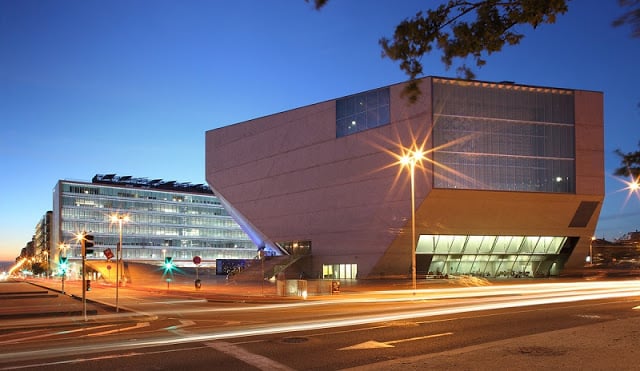
Aarón Esteve makes a brief review of Casa Da Música’s new season of concerts, and writes about some of them.
Like any concert institution, September arrives and that is synonymous with a new season. The weekend of 7-10 September took place the concerts that kicked off the musical season at Casa Da Música in Porto. A series of concerts where variety is the keynote and the fact that most of the concerts are free of charge is a pleasant surprise for the public.
On September 7th, I attended the first concert performed by the artist Lívia Mattos who, together with her group formed by a drummer and a tuba player, performed her new album entitled «Apnéia». During the concert held outdoors at the doors of the main building Casa Da Música, pieces of various musical styles from free jazz to fado were performed.
A varied concert in terms of its proposals, innovative in terms of sonority, and relaxed on the part of both musicians and audience, which contributed to a very peaceful performance.
The second day, the Children’s Choir Casa Da Música gave a concert, in which a change was observed in terms of the concert’s target audience.
The stalls were almost full and most of them were children. It was a concert conducted by Raquel Costa whose programme consisted entirely of pieces by Jim Papoulis and Eric Whitacre where the melody was the essential element throughout the concert and the interactions of the choir with the audience making them sing or participate in the performance by means of body percussion was the general trend.
I thought it was a good way to show the new generations that the concert format doesn’t have to be a serious and boring format but that it can be fun, interactive and attractive, making the audience not only listen but be part of something much bigger.
The third day of concerts took place on the September 9th on Av. dos Aliados, a central avenue in Porto, where the Orquestra Sinfónica Do Porto Casa Da Música conducted by Diogo Costa performed a more conventional programme, aimed at a more conservative and adult audience.
The programme consisted of the following pieces:
– Ribatejo by Federico de Freitas
–The Sorcerer’s Apprentice by Paul Dukas
– Adagio from Aram Khachaturian’s Spartacus and Phrygia
– Schindler’s List by John Williams
–Symphonic Dances from West Side Story by Leonard Bernstein
Due to the location of the concert, the acoustics were not the best to hear the orchestra in all its splendour, but the audience reacted effusively to the different pieces that were performed, and the concert concluded with the performance of two tips.
Finally, on the 10th, the concert took place starring the Portuguese Symphonic Band, which together with its director Juan Wierzba performed in the first part the finalist works in the XI BSP National Composition Competition.
The three selected works were inspired by verses by the poet and writer Sophia de Mello Breyner Andresen.
The works to be performed in this first part were:
–Túmulo de Sophia by Miguel Tiago Moura
–O Silêncio by Alfonso of Portugal
–Through my Glassy Veil by Francisco Ribeiro
The three programmatic pieces were well received by the public and although all of them could be classified as tonal, there were notable differences between them, we found both stylistic and timbral differences in various musical resources used for the dramaturgy of the text that was being recited by Susana Branco.
The winner of the competition turned out to be Ribeiro’s piece, who won both the jury (made up of Juan Wierzba and Pedro Lima) and the public prize.
The second part was a world premiere. The scene cantata “Delícia de Morangos e Chantilly”, whose libretto was signed by the playwright Edward Luiz Ayres d’Abreu and the music was composed by the composer Pedro Lima, was performed.
The main novelty of this performance was that various sources of artificial intelligence were used to create the script, such as the well-known ChatGPT.
On the other hand, the work was a continuous parody of today’s society, the use of fillers when speaking and the obsession with «real» food. All this after a love plot that was weakened by the ironic winks of the script.
Overall, all the concerts were sublime. However, it would have turned out much visually attractive if the weather conditions would have let celebrate them where they were supposed to.
In conclusion, we can say that Casa da Música do Porto has been able to create a start to the season in accordance with the concerns of the various types of audiences.
This generates an atmosphere of proximity and variety in terms of the public, expanding the cultural offer of the city and thus helping to avoid stagnating by always performing the same type of music.
After all, I would like to emphasize the need of creating such proposals in some Spanish musical institutions.
Review by Aarón Esteve.
 MIKROKOSMOS